





Home >> Socio Short Notes >> Mental Illness: A Sociological Perspective
Mental Illness: A Sociological Perspective
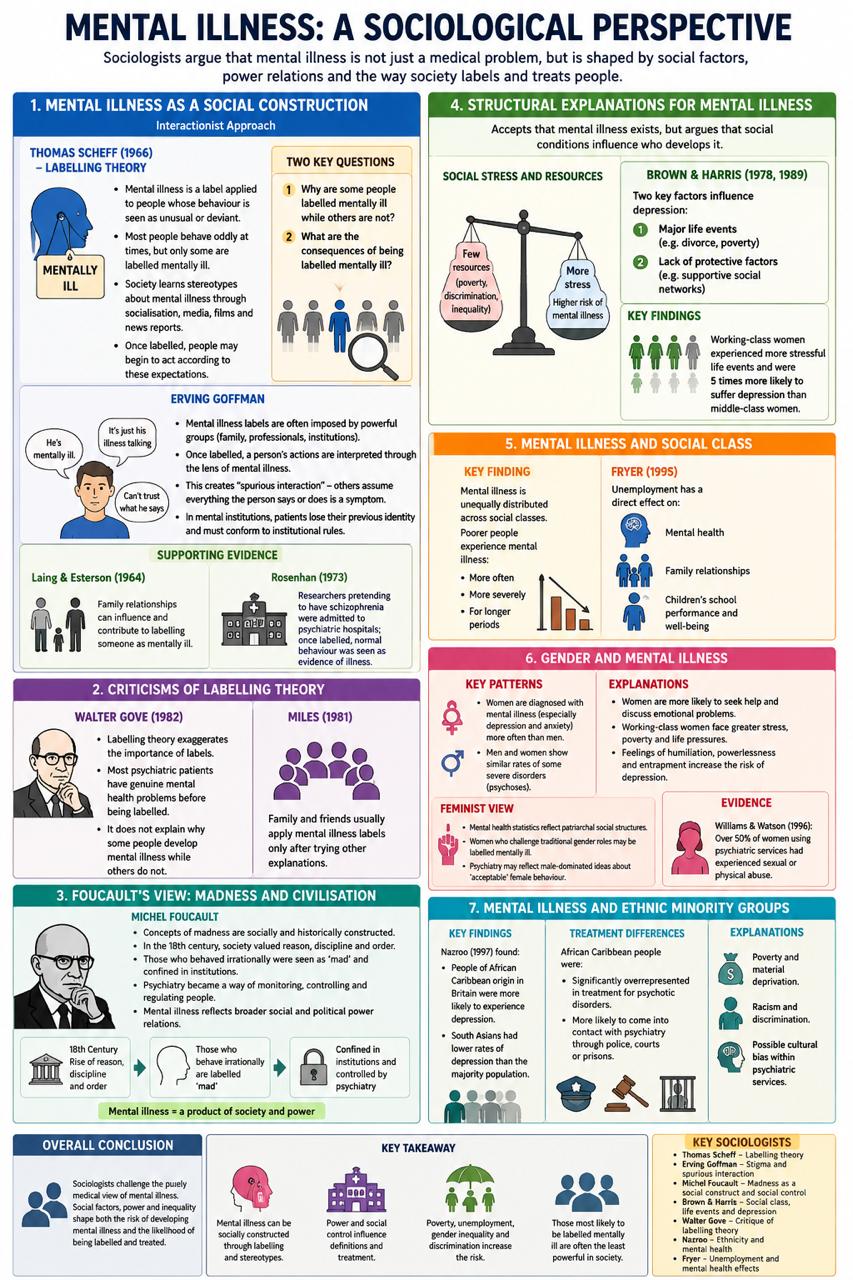
Mental illness has traditionally been viewed as a medical issue rooted in biological or psychological causes. However, sociologists argue that mental illness cannot be fully understood without considering the social environment in which people live. Sociological perspectives emphasize that social factors such as poverty, inequality, gender, ethnicity, social relationships, and societal reactions play a significant role in shaping both the experience of mental illness and the way it is defined and treated.
One influential sociological approach is the Social constructionist or interactionist perspective, particularly associated with the work of Thomas Scheff. Scheff argued that mental illness is not simply a medical condition but also a social label applied to individuals whose behaviour is considered unusual or deviant. According to this view, most people display odd or unconventional behaviour at some point in their lives, but only a minority are labelled as mentally ill. Society learns stereotypes about mental illness through family, education, media, films, and news reporting, and these stereotypes influence how people perceive and respond to those labelled as mentally ill.
Building on this idea, sociologist Erving Goffman examined the consequences of labelling. He suggested that once an individual is labelled mentally ill, others begin to interpret all of their actions through that label. This process, which Goffman referred to as “spurious interaction,” means that the person's thoughts, feelings, and behaviours are no longer judged on their own merits but are instead viewed as symptoms of illness. Goffman also highlighted how mental institutions often strip individuals of their previous identities and require them to conform to institutional rules and expectations.
Research by Laing and Esterson further demonstrated how family relationships can contribute to the process of labelling. Their study suggested that behaviours interpreted as symptoms of mental illness may sometimes reflect complex family dynamics rather than individual pathology. Similarly, Rosenhan's famous experiment showed how psychiatric labels can influence perceptions. Researchers who pretended to hear voices were admitted to psychiatric hospitals, and once labelled as mentally ill, their normal behaviour was frequently interpreted as evidence of mental disorder.
Despite its influence, labelling theory has been criticized. Walter Gove argued that the theory overstates the importance of labels and overlooks the fact that many psychiatric patients experience genuine mental health problems before any label is applied. Critics also point out that labelling theory does not adequately explain why some individuals develop mental illness while others in similar circumstances do not. Research by Miles suggested that family members and friends often resort to mental illness labels only after other explanations for behaviour have been considered.
A different perspective was offered by French sociologist Michel Foucault. In his work Madness and Civilization, Foucault argued that ideas about mental illness are shaped by historical and social forces. He suggested that the concept of madness emerged alongside the rise of rationality, discipline, and social control in modern society. As societies increasingly valued order and reason, individuals who behaved in ways considered irrational or disruptive were classified as mentally ill and confined to institutions. According to Foucault, psychiatry became a means through which societies monitored, regulated, and controlled those who deviated from accepted norms.
While interactionist approaches focus on social reactions and labelling, structural explanations examine how broader social conditions contribute to mental illness. This perspective accepts the existence of mental illness but argues that social inequalities significantly influence who is most likely to experience it. Individuals with fewer economic and social resources often face higher levels of stress, making them more vulnerable to mental health problems.
Research by Brown and Harris on depression among women highlighted the importance of social circumstances. They identified major life events, such as divorce and poverty, as key triggers of depression, while supportive social networks acted as protective factors. Their findings showed that working-class women were more likely to experience stressful life events and significantly more likely to develop depression than middle-class women.
The relationship between social class and mental illness has been consistently demonstrated in sociological research. Studies show that mental illness is not distributed evenly across society. People living in poverty tend to experience mental health problems more frequently, more severely, and for longer periods than those with greater economic resources. Unemployment, insecure work, and financial hardship can all contribute to poor mental health, while also affecting family relationships and children's well-being.
Sociologists have also examined the relationship between gender and mental illness. Research by Brown and Harris on depression among women highlighted the impact of gender and mental illness. Women are diagnosed with mental health conditions, particularly depression and anxiety, more frequently than men. While some researchers suggest this may partly reflect women's greater willingness to seek professional help, others argue that women are exposed to social pressures and inequalities that increase their vulnerability to mental distress. Brown's later research emphasized the role of humiliation, entrapment, and lack of control in women's lives as important contributors to depression.
Feminist sociologists have argued that mental health statistics cannot be understood without considering gender inequality. They suggest that women who challenge traditional gender roles may be more likely to be labelled as mentally ill, and that psychiatric practices may sometimes reflect broader patriarchal assumptions about acceptable female behaviour. Research has also highlighted the high prevalence of physical and sexual abuse among women receiving psychiatric treatment, pointing to the impact of power inequalities and violence on mental health.
Another important area of sociological inquiry concerns mental illness and ethnicity. Research in the United Kingdom has found significant differences in mental health experiences and treatment among ethnic groups. Studies indicate that people of African Caribbean origin are more likely to be diagnosed with certain mental health conditions and are disproportionately represented in psychiatric treatment services. They are also more likely to come into contact with mental health services through the police, courts, or prisons rather than through community-based support systems.
Sociologists suggest that these patterns may be linked to factors such as poverty, discrimination, racism, and social exclusion. Some researchers have also raised concerns about cultural bias within psychiatric institutions, arguing that behaviours may sometimes be misunderstood or misinterpreted due to differences in cultural norms and experiences.
In conclusion, sociological perspectives challenge the view that mental illness can be understood solely as a medical condition. Instead, they emphasize the importance of social processes, power relationships, and structural inequalities in shaping both mental health and society's responses to mental illness. Whether through labelling, social control, poverty, gender inequality, or discrimination, sociologists demonstrate that mental illness is deeply connected to the social world. These perspectives highlight the need to address not only individual symptoms but also the broader social conditions that influence mental well-being.



 |
© 2026 sociologyguide |
 |