





Home >> Socio Short Notes >> Sociology of Hate
Sociology of Hate
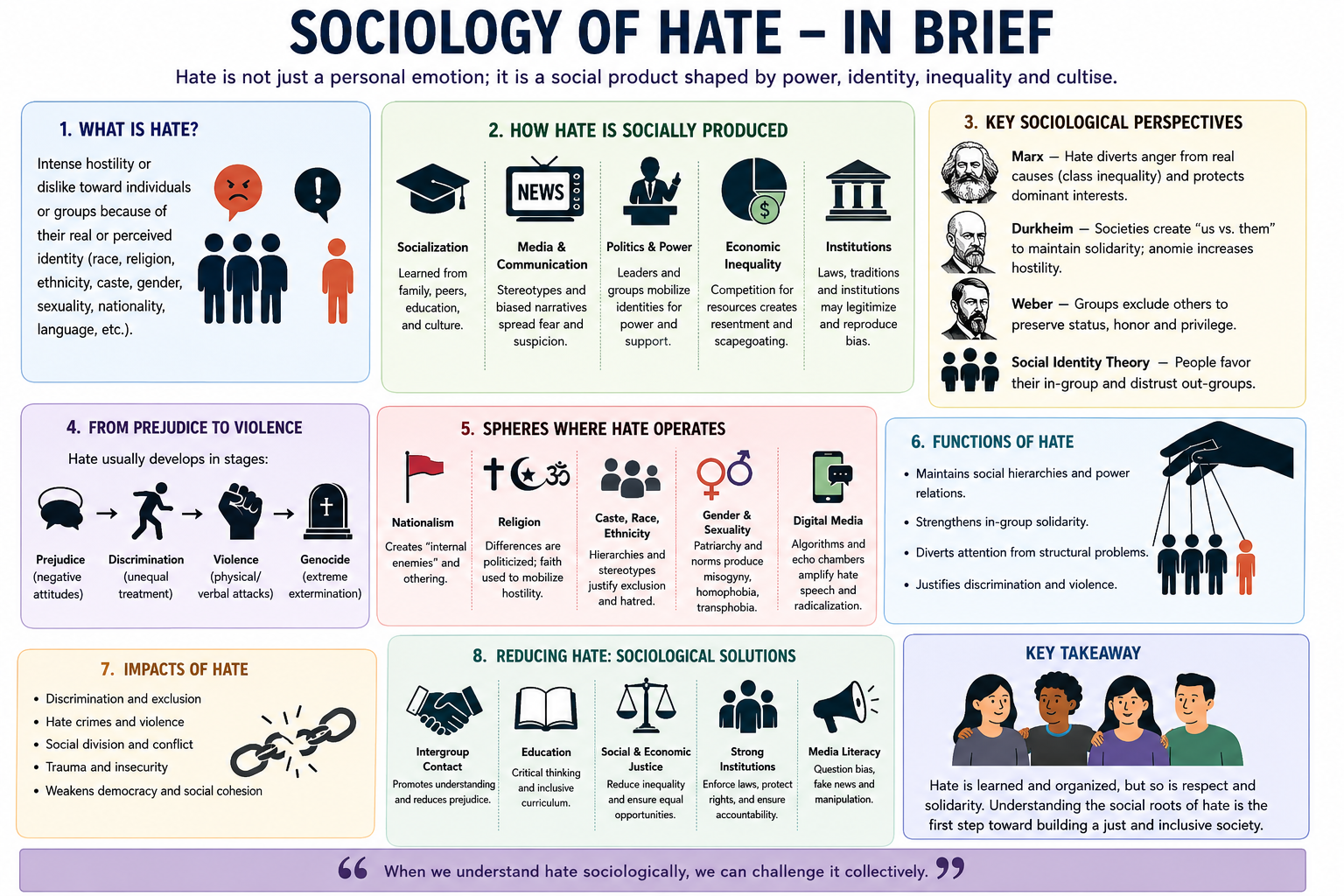
The sociology of hate examines hatred not merely as an individual emotion but as a socially produced phenomenon shaped by institutions, power relations, collective identities, and historical experiences. Sociologists argue that hatred toward racial, religious, ethnic, caste, gender, or national groups develops through socialization, political mobilization, media narratives, and structural inequalities rather than through isolated psychological impulses alone. Hate therefore becomes embedded within systems of domination and social control, often serving functions such as maintaining hierarchy, strengthening group solidarity, or mobilizing political support.1
Karl Marx explained social hatred through the framework of class conflict and ideology. Marx argued that ruling classes frequently divert public frustration toward minorities in order to preserve existing economic systems and prevent class unity. Racism, nationalism, and communal hatred can therefore function as forms of “false consciousness” that obscure the real causes of exploitation and inequality. In capitalist societies, marginalized groups are often blamed for unemployment, poverty, or crime instead of structural economic failures.2 Marx’s perspective remains highly relevant in understanding how political elites manipulate social divisions to maintain dominance.
Émile Durkheim viewed hate through the concepts of collective consciousness and social solidarity. According to Durkheim, societies maintain unity by distinguishing acceptable behaviour from deviance. Communities often strengthen internal cohesion by identifying outsiders or enemies against whom collective emotions can be directed. During periods of rapid social change or “anomie,” when traditional norms weaken, hostility and moral panic become more common. Hate thus emerges from anxieties related to social instability and the breakdown of moral regulation.3
Similarly, Max Weber connected hatred to status competition and social closure. Weber argued that social groups attempt to monopolize prestige, opportunities, and resources by excluding outsiders. Religious groups, caste systems, ethnic communities, and nationalist movements create symbolic boundaries to preserve privilege and honour. Hatred develops when dominant groups perceive others as threats to their social status or identity. Weber’s framework is especially useful for understanding caste discrimination, xenophobia, and communal conflicts where exclusion is justified through notions of purity, culture, or national belonging.4
Modern sociology further developed these ideas through social identity theory proposed by Henri Tajfel and John Turner. This theory suggests that individuals derive self-esteem and identity from group membership, leading people to divide the world into ingroups and outgroups. Even minimal group distinctions can produce favouritism toward one’s own group and hostility toward outsiders. Sociologically, this explains why ethnic, religious, and nationalist politics often intensify hatred by emphasizing symbolic boundaries and collective identities. Hate therefore becomes a mechanism for strengthening group cohesion and reinforcing a sense of belonging.5
Conflict theorists emphasize that hatred is deeply rooted in systems of inequality and domination. Racism, casteism, sexism, and xenophobia are not merely personal prejudices but ideological systems that justify unequal power relations. Colonialism, slavery, apartheid, and caste hierarchy historically depended upon narratives portraying certain communities as inferior, dangerous, or uncivilized. Sociologists argue that such ideologies normalize exploitation and exclusion.B. R. Ambedkar demonstrated this clearly in his analysis of caste, arguing that caste represents not simply a division of labour but a “division of labourers.” He showed how ritual hierarchy and social segregation institutionalize humiliation and hatred within society.6
Symbolic interactionists focus on how hate is reproduced through language, labels, symbols, and everyday interactions. Stereotypes and media representations shape public perceptions of social groups and often normalize prejudice. Howard Becker’s labelling theory explains how societies define certain groups as deviant or threatening through social processes of categorization. Media discourse, political rhetoric, jokes, and online communication all contribute to constructing meanings associated with fear and suspicion. Hate therefore operates not only through physical violence but also through symbolic violence embedded within everyday communication.7
The sociology of prejudice and discrimination became especially influential through the work of Gordon Allport. In The Nature of Prejudice, Allport argued that prejudice is socially learned and can escalate gradually from verbal hostility to discrimination, physical violence, and even genocide. He identified a progression through which societies normalize hatred over time. This framework remains central in sociological analyses of communal violence, racism, and ethnic conflict because it demonstrates how seemingly ordinary prejudice can evolve into organized violence.8
The study of hate crimes further reveals how hatred functions as a mechanism of power. Sociologist Barbara Perry argues that hate crimes are not simply attacks on individuals but symbolic acts directed toward entire communities. Such violence reinforces social hierarchies by communicating who belongs within society and who remains vulnerable or excluded. Hate crimes therefore serve as mechanisms of intimidation that reproduce dominant-subordinate relationships. Lynching, communal violence, and attacks on minorities often carry broader social messages intended to instil fear within entire groups.9
The digital age has transformed the sociology of hate by expanding the role of social media, online networks, and algorithmic amplification. Sociologists studying digital communication argue that online spaces create echo chambers in which extremist ideologies and hateful narratives spread rapidly through repeated exposure. Hate speech becomes normalized when stereotypes and conspiracy theories circulate unchecked within digital communities. Media sociology therefore examines how online platforms contribute to polarization, radicalization, and the creation of virtual communities organized around hostility and exclusion.10
Nationalism and religion also play central roles in the sociology of hate. Sociologists observe that nationalist movements often construct “internal enemies” portrayed as threats to national unity, security, or culture. Religious identities become politicized when social conflicts are framed as sacred struggles between communities. Hatred in such contexts is rarely theological alone; rather, it is connected to struggles over political power, territory, and cultural dominance. Processes of “othering” and scapegoating become especially visible during communal violence and periods of political instability.11
Feminist sociology contributes important insights into misogyny, homophobia, and gender-based hate. Patriarchal societies frequently direct hostility toward women and LGBTQ+ individuals who challenge traditional gender norms. Feminist scholars argue that violence against women is structurally connected to systems of patriarchy and male dominance rather than being random acts of aggression. Gender hatred thus functions as a mechanism of social control designed to preserve existing power relations and heteronormative social order.12
The sociology of genocide demonstrates the most extreme consequences of organized hatred. Hannah Arendt argued that mass violence often emerges not simply from irrational hatred but through bureaucratic systems, propaganda, and institutional obedience. Her concept of the “banality of evil” showed how ordinary individuals can participate in atrocities when violence becomes normalized through state structures and ideology. Sociologists studying genocide identify processes such as classification, dehumanization, polarization, and organization as stages through which societies move toward mass extermination.13
In conclusion, the sociology of hate reveals that hatred is not merely an emotional or psychological phenomenon but a deeply social process rooted in inequality, identity politics, institutional power, and historical conflict. Sociological perspectives demonstrate how hate is learned, normalized, institutionalized, and reproduced through media, education, religion, nationalism, and economic systems. Understanding hatred sociologically therefore helps explain why prejudice and violence persist across societies and how democratic institutions, social justice, education, and intergroup dialogue can reduce exclusion and promote coexistence.
Footnotes / References
- Jack Levin & Jack McDevitt, Hate Crimes: Causes, Controls and Controversies (Thousand Oaks: Sage Publications, 2002).
- Karl Marx, Capital (1867).
- Emile Durkheim, The Division of Labour in Society (1893).
- Max Weber, Economy and Society (1922).
- Henri Tajfel and John Turner, “An Integrative Theory of Intergroup Conflict,” in The Social Psychology of Intergroup Relations (Monterey: Brooks/Cole, 1979).
- Dr. B. R. Ambedkar, Annihilation of Caste (1936).
- Howard Becker, Outsiders: Studies in the Sociology of Deviance (New York: Free Press, 1963).
- Gordon Allport, The Nature of Prejudice (1954).
- Barbara Perry, In the Name of Hate: Understanding Hate Crimes (New York: Routledge, 2001).
- Matamoros-Fernández, Ariadna, et al., “Hate Speech in Social Media: A Systematic Review,” arXiv (2017).
- Ruth Wodak, The Politics of Fear: What Right-Wing Populist Discourses Mean (London: Sage, 2015).
- Allan G. Johnson, The Gender Knot: Unraveling Our Patriarchal Legacy (Philadelphia: Temple University Press, 2014).
- Hannah Arendt, The Origins of Totalitarianism (1951).



 |
© 2026 sociologyguide |
 |